When it comes to racing skills, one of the hardest is racing from the front… and then looking back. It saps your energy. If you’re in the front… don’t look back, it is a giant killer.

In the Canadian Olympic swimming trials in 1988 a giant fell to two unexpected young swimmers.
At the Olympic trials, new standards for qualification had been set in place by the powers given to the National Performance Director (NPD). Those new standards were set very very high. It was equal to eighth place in the world (two places per country, which meant if a country like USA had three in the top eight the third person wouldn’t be included). Previously swimmers had to race together at the trials and try to make top two in the country. No time standard included, just placing.
Some swimmers would not struggle to make that standard. Normally these kind of swimmers could simply win. Their time would not matter, just the placement.
There was some kick-back on this new time standard that was in addition to top two placement, by swim coaches across Canada, so the times were eased slightly to twelfth place ‘absolute’. So statistically a very small change. Swimmers still had to perform though; whether they were former national champions, Olympic gold medalists, world record holders…or not.
The kick-back was understandable. Only one Olympic quadrennial cycle had been completed since the debacle of Moscow 1980. An entire generation of elite swimmers was lost in 1980 and although Los Angeles 1984 was hugely successful, a Canadian NPD (or dictator) had been hired ‘to shake things up’. Potentially another future generation was going to be lost.
Anyone wanting to attend the 1988 Olympic Games would be thrown at a standard that is normally only attained once per year. So swimmers marched to the Trials in Montreal to see who didn’t break.

This created a pinch point for the top swimmers. The Olympic Games was no longer the singular goal. First jumping through this trials hoop in May was necessary. It was a giant killer if you were focusing on the Olympics only.
To be fair there has to be some kind of qualification system. Who would represent each country at the Olympics without it?
Sending a swimmer to an Olympics is expensive. Without looking beyond the current year, selecting only the podium swimmers would make sense. Politicians decided the funding and only medals mattered. There is no need for simple participation! Medals got publicity and politicians love publicity!
Statistically those who were outside top eight never won medals. I suppose Duncan Armstrong set that idea on its head ironically at the 1988 games.
Making the Olympic Games is the ultimate challenge of many athletes. Some professional sports like tennis, golf or football don’t have this pinnacle but in swimming it is.
Two young breaststroke swimmers from Alberta had a mountain to climb. They knew one spot was taken; the world record holder and Olympic champion in 1984 Victor Davis. This giant of Canadian swimming dominated the world in breaststroke especially in 200m. He had smashed the world record previously in the world championships and again at the 1984 Olympics. But now, with a new time standard set, he couldn’t just win the trials, he had to make the time standard. His spot was almost guaranteed in everyone’s mind…

I loved to watch Victor race. He was an artist. His stroke cruised and floated. He was a muscular swimmer and a bit of a show-off. But if you were modelling for Speedo, had the world record, and were the reigning Olympic champion, you might be a bit of a show-off too.
Standing in the starting blocks, on either side of him, at the Canadian Olympic trial final of 200m breaststroke, were two teenage boys. I’m sure Victor didn’t know their names. They had never been on a national team. They knew that they had to make the time standard and be second place. If they came third, and had the third fastest time in the world, they were still watching the Olympics on TV. One of these three, was not going to go to the Olympics for 200m breast.
Victor might not have known it but he had a target on his back. If either of these two boys were even close to him they would likely make the time standard. To them he was their prey.
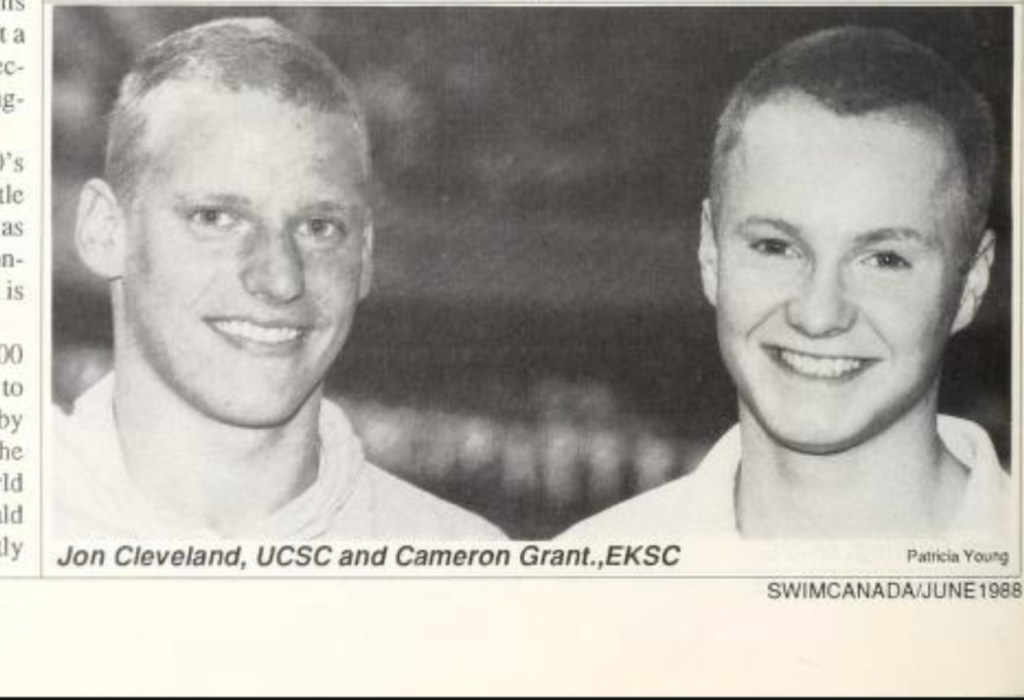
Then it happened. A race that still rocks my brain. Victor, who had not rested for the Trials, had not thought he needed to, was totally focused on the September Olympics, took control of the race. He split a 100 time that was not too far off the 100 world record. Maybe a slightly cocky split time to show-off a bit to his international friends. Two young boys from Calgary and Stettler Alberta weren’t too far from him at the 150m turn.
I think that at that 150m turn Victor realised he had made a mistake. In his mind he started to be chased. Two boys, like two hungry young mountain lions, were hunting him. Victor had gone out too fast. He started to fade. And at that point in my life, as Victor’s perfect stroke began to slip water, I realised that sometimes even a giant can be beaten if they look back.
Racing from the front takes courage. A courage looks only forwards. Backward glances are doubt. Somewhere in our soul doubt is a feeling of darkness from our imagination.
When I lived on Vancouver Island a local story often came up of a guy cycling home from work near Lake Cowichan. Two young cougars leapt out of the woods behind him and began to chase him. He could hear their claws clicking on the tarmac getting closer and closer. He pedalled furiously away from the hungry felines. The fear had hit him. There was only one outcome if he was caught. Luckily another guy in a pick-up truck overtook the young cougars and the cyclist jumped into the back. There was no pick-up truck for Victor.
The primal fear that we feel when chased must come from stories and images we conjure up in our mind’s subconsciousness. Sometimes it is so debilitating we crumble. So even if you are a giant…don’t look back.
Do you want to join in the discussion with Gary? Join in his Skool and get started: https://www.skool.com/performance-swim-strokes-6754/about


 swimcoachingblog
Pingback: mymusings 1965