The author of the first book on swimming in the western world was a man called Everard Digby. His book was published in 1587 and was written in vulgate latin.
The title was De Arte Natandi libre duo or more specifically ‘De Arte Natandi libri duo, quorum prior regulas ipsius artis, posterior vero praxin demonstrationemque continet’. This translates to:
Two books on the art of swimming, the first of which contains the rules of the art itself, and the latter contains practice and demonstration.
The translation of that book was called A Short Introduction For To Learne To Swimme published not long after in 1595. Instructional books at this time began to emerge due to the invention of the printing press.
This was an unusual book written at a time when Protestant, Puritan, Lutheran and Catholic folk were disagreeing on most things, especially translations of the bible. Countries, Regents and Universities were flip flopping around what type of Christianity they adhered to.
Days, months and years of time spend banning people, beheading people, and changing philosophical paths. The King of England at this time denounced them all and made his own church. Every branch or direction required different bible translations and kept the presses busy. For example: in 1538 Chancellor Thomas Cromwell ordered that every church should have an English translation of the Bible.
Some non-religious preoccupations were slowly emerging; works of instruction, travel guides, collections of poems, romantic novels, histories of art and architecture, cooking and medicinal recipes, maps, posters, cartoons, and sheet music. Readership though was limited. Only academics and the gentry could read.
It was a time when printing was regulated but copyright was not yet a thing. Anything printed had to be officially licensed. So anything printed had to have a printers stamp on it but anyone could use anyone else’s ideas or translate them.
The earliest sport instruction work of the time was one published on archery by Roger Asham. He was also a scholar from St John’s College, Cambridge on their new printing machine. He defended his love of archery, argued that even scholars were able to be competent and praised Henry XIII extensively in it.

Digby authored a book on swimming because he was a very capable swimmer, however swimming would have been a strange topic to put into print. Essentially because swimming was illegal frowned upon. As a Fellow of Cambridge though, he was not governed by local law but that of the college. He was a rebellious man and was not ashamed to show his displeasure. He eventually did get dismissed from the College. However had a long rap sheet by then. He had been known to blow a horn during lectures obviously to disrupt the speaker. Probably his Catholic leanings provoking a Calvinist speaker. He had an unpaid debt, which was illegal but he was disputing the way the debt was written. He also would head down to the beautiful river that runs through Cambridge and fish when he was obligated to be at a church service. As a catholic he likely was protesting the style of service in an Anglican or Calvinistic gathering.
He had earned a place in the college through the system of sizer. This meant you had to work as a servant to other students during your education because you could not afford the fees. A scholarship without any benefits. A sizer had to wear a different set of clothing. Later he became a Fellow of St John’s College, Cambridge proving his intellect.
He followed in Asham’s footsteps to produce an instructional book, possibly because Asham had been granted a £10 annual pension by Henry XIII and he was hoping for the same. A pension of that amount was like a full time salary.
Digby published his work at a time when not many people could read. In the century from 1450 to 1550, English and German literacy grew from 7% of the population to 16%. Digby was filling a new market but strangely wrote in vulgate Latin which was incomprehensible to anyone except scholars and bishops.
Writing in Latin was also strange for an instructional book. It was a book on how to do something that required to strip off and go into the river. He possibly was being rebellious and I think he was snubbing the higher-ups. Possibly saying don’t be so snobbish, get your hose off and go swimming! However swimming was considered evil like cards, dancing and exposing any portion of the body.
In the block prints there are some undressing individuals on the riverbank. The dress, hosery and hat being shown are specifically the attire of a wealthy person. In fact, what you could or could not wear was governed by law. Digby would have been highly aware of who wore what, since he spent his early years dressed as a lowly Sizer.
The rich loved their games and had loads of leisure time. The definition of a gentleman was a non-working person.

Wealthy people had leisure time. Research into the 16th century shows that in leisure they liked wrestling and ‘casting the bar’, which was like shot-putting but with an iron bar. They also played billiards and also played board games like chess and backgammon. They played tennis with a leather ball stuffed with hair and also played bowls and skittles. In Scotland they played golfe.
Digby was a proponent of Aristotelian thinking and education. Although he seems to be a bit of a rebel and knew about the art of swimming he knew that swimming was considered essential learning by Aristotle. Plato taught Aristotle and Plato said that a man is not learned until he can read, write and swim.

Since swimming is a skill that requires teaching, and few people could swim at this time, the skill had to be passed on by writing and the new invention of a printing press was a perfect way to pass on that knowledge. Digby felt he was the one to fill that role and since Aristotle’s philosophy played a major theme in teaching at that time at universities, Digby felt it was hypocritical not to write a book on swimming; nude or not.

Digby was an unusual character and was known to show off his swimming skills. He would float on his back and lift up his toes, he would spin in circles and generally frolic to people’s amazement. He also was dismissed from his fellowship at Cambridge College, not for his swimming antics and writings on swimming but also for incurring debt, fishing when he should have been in chapel, and for his odd behaviour out of water.
Digby passed on his rebellious streak to his son, also Everard Digby. Later a famous member of the Gunpowder Plot. That particular bit of rebellion got his son hung drawn and quartered. But at least it makes every November 5th a colourful night.
An original can be found in the British Library:

The woodcut prints show various swimming activities but other portions (not shown here) cover things like ‘to turn in the water like a roach’ or ‘to hang by the chin in the water’. I would like to re-establish Roachstroke and hold a world record.
The following are a sample of the woodcuts in his book:

These directions are sufficient either for his entrance which is yet to learn, or for his which is already expert in this faculty.
Now that is learning to swim, as we said afore, having waded in up to waist or somewhat higher, laying himself easily along upon the water with his belly downward, and striving as much as he can to hold up his head, and draw[ing] in his arms close to his breast, holding hands broadways together under his chin with the palms down; let pull his feet from the bottom and withal put forth his hands as far as he can and draw them in again as afore, and likewise his feet.
Which double motion of hands and feet serve to this use: the one thrusteth him forward and the other keepeth up his body.
And because it is a toil, something to learn how to strike right thus with his hands and feet as afore, let him either get someone to accompany that may by holding his hand under his chin keep him from sinking, else take two bladders, blow them full of wind and fasten them so together that he may have them to lie under his armholes, which will easily bear him up.
And thus may he do till he hath perfectly learned to swim on his belly, as the picture showeth.

Into this kind of swimming many do at the first fall, before they perfectly learn the right stroke.
And there is this difference betwixt them, that.whereas in the right kind [of stroke] he stretcheth out his hands and his feet, in this he rudely beateth the water with his hands and feet, first lifting his right hand out of the water and then his right foot, and forcibly striking them into the water again, as in this example.

This is also done by lying straight upon his back, stretching out his feet together at length, and moving with his hands in the water as in the former example, and so lifting up his feet till he hath brought all his toes above the water, as thus.
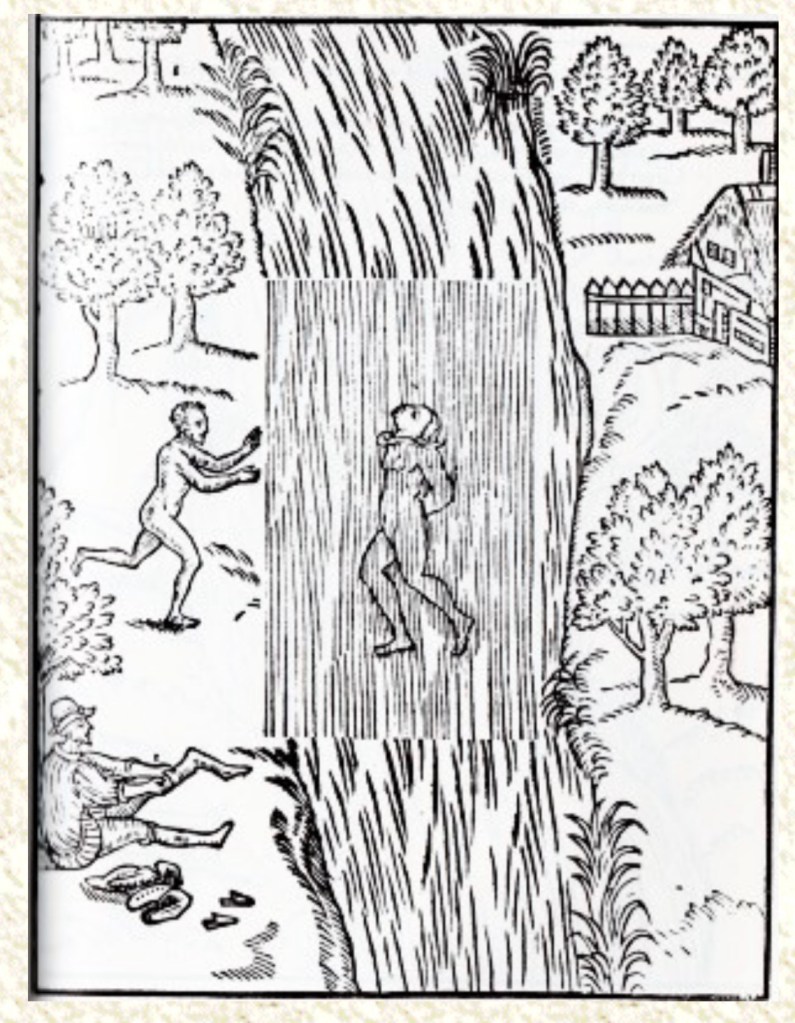
This is only standing bolt up as it were in the water, and pulling up your feet and thrusting them down again, after the same manner as he doth swimming upon his belly, which have the same force to keep him that way which they have to thrust him forwards the other way, as you may see in this picture.

He must, if he be in a place where he may stand upon the ground, with as much force as he can, leap up, and bending his head towards his breast fall forwards down into the water, as thus.
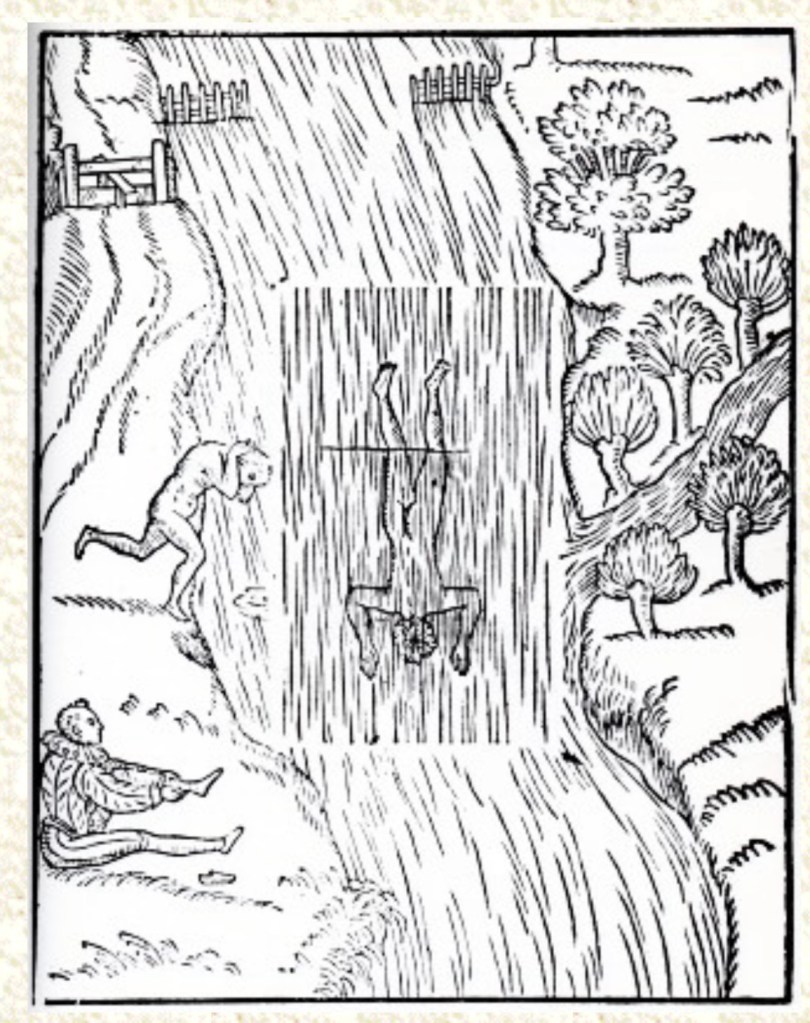
His hands must he hold before his head with their backs together, that they may be ready to pull him as it were forcing him down under the water, and he must, pulling them out and in, now use them to help him down which were afore a means to hold him up.
His feet also must strike upward, moving them after the same manner as he doth swimming above the water upon his belly, after this example.

When he hath thus buried himself in the water, he must thrust his hands forth before his head and, as it were, draw the waters which are before and beat them behind him, [and] strike with his feet as swimming upon his belly, but somewhat upward that they may the easilier keep him down, as in this example.
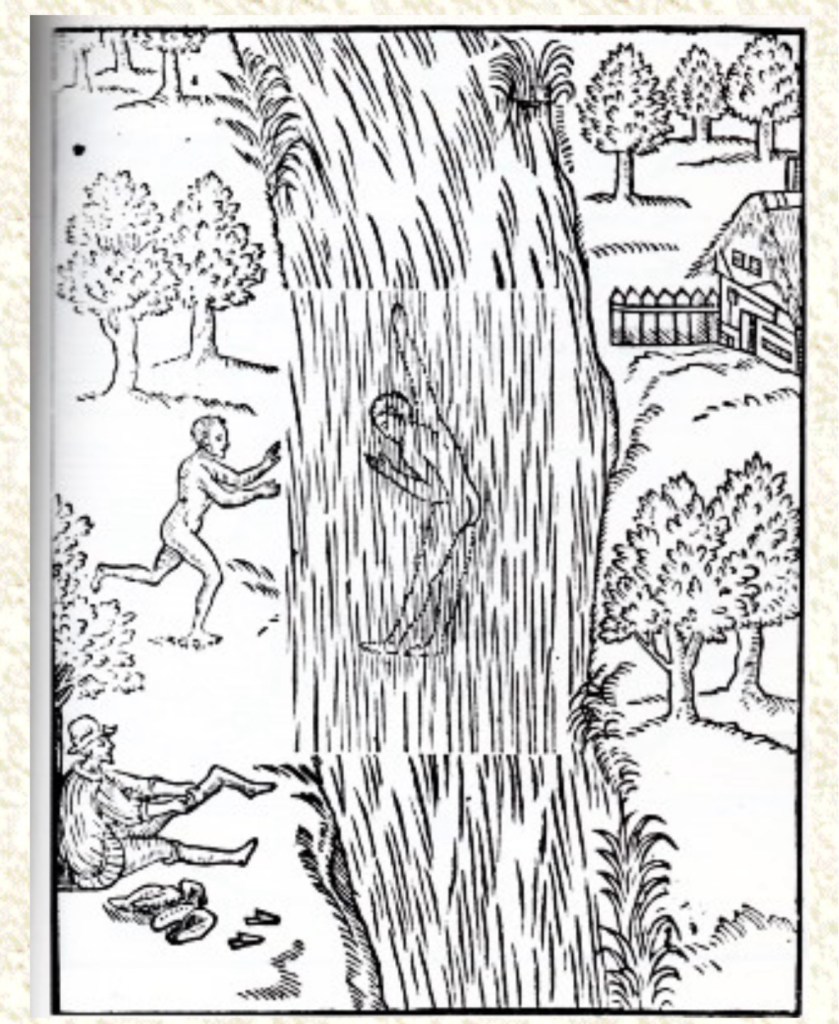
That is done by the speedy turning upward of his body and with one hand, the palm being downwards, press down the water beneath him, and with the other hand draw down the water which is above him, and then striking downwards with his feet it will easily bring him up, as thus.

He must swim under the water as afore but as near the bottom as he can, so that he touch it not lest he raise any mud to thicken the water, his eyes open that he may see where it lieth.
And if so be that he have any occasion to turn himself, or to seek round about as thinking himself near the thing he seeketh, if he will turn towards the left hand, he must with his right hand pull towards him the water which is on his left side, which will easily turn him about, as this picture next following showeth by example:
But thus much to him which learneth to dive: let him never swim further than he can see the bottom, for it is either very deep or else he is under some bank, or in some such danger.

This is nothing else but in diving to lift his head above the water, and when he hath breathed, presently dive down again, as afore.
Do you want to join in the discussion with Gary? Join in his Skool and get started: https://www.skool.com/performance-swim-strokes-6754/about


 swimcoachingblog
Pingback: How Breaststroke Was Saved…Twice | swimcoachingblog