
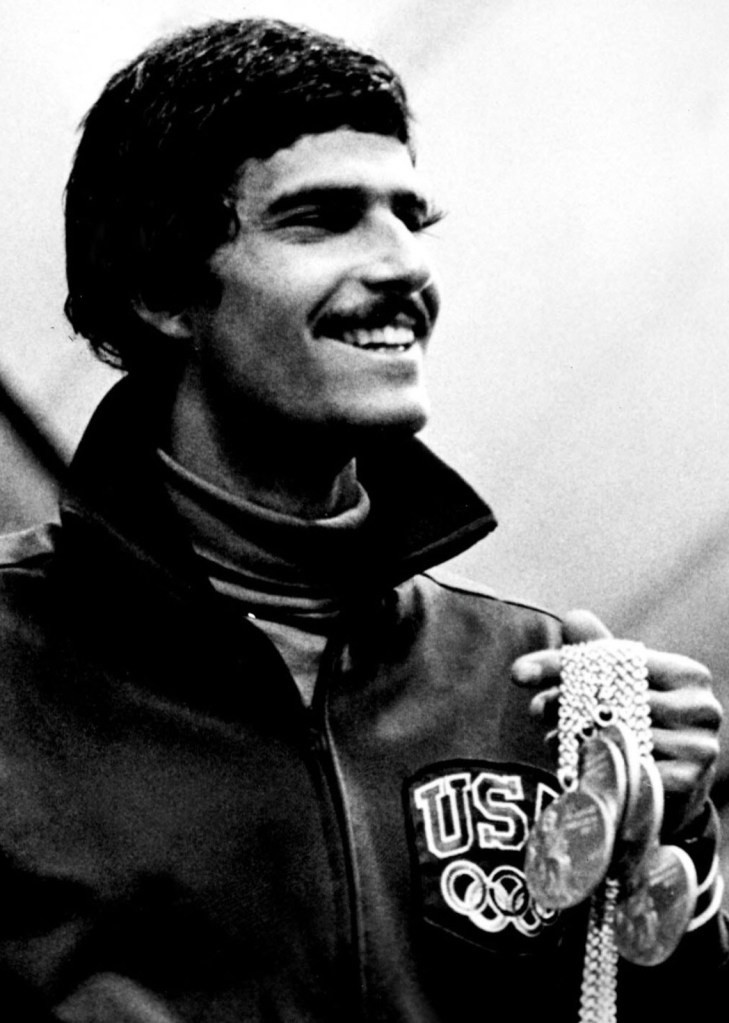
A combination of a genius coach and an unconventional swimmer, resulted in a fistful of gold medals in the 1972 Munich Games. Mark Spitz became an icon as the first person to win seven golds at one Olympic Games.
People might think that Spitz was simply a godlike swimmer and that was it. His story is a bit more colourful than that. Without James ‘Doc’ Counsilman, there would not have been a seven medal hall by Mark Spitz but more likely a repeat of Mexico City 1968.
Observers of the 1972 Olympics remember; gold, gold, gold, gold, gold, gold and gold for Spitz. This was memorable for a long time, especially if you’re from that era, but less known in the post Phelps era. So it might not be a surprise to me if you didn’t know that he won a silver in his 100m Butterfly and bronze in his 100m freestyle in his first Olympics.
To most 18 year old swimmers, a silver and a bronze would be an amazing first Olympics, plus two more medals on his relays. The relays were almost a certainty since USA was rarely beaten in relays but not winning his individual races was unexpected.
Spitz was the world record holder in 100m Butterfly and he had predicted he’d win six golds in Mexico City. So his silver/bronze haul was not as predicted by the braggadocious youngster and even got bumped off the medley relay.
Spitz was an unusually talented age group swimmer who was obsessively competitive. He was also very anti hard-work. He was known for avoiding hard training like an escape artist. He would take long pee breaks and water breaks constantly. He’d get out of training regularly with a litany of ailments. He was the worst, fast-swimmer, of your team. A role model for how to skive and slack-off.
However, whenever a time trial came up, or ‘stand up swim’ or a competitive swim, he’d never be beaten. He was a totally compelled boy to win but loathed being sore from training. He would not loose well, pouted about it, but this rarely happened because he would always win. He could produce swims well beyond his training capacity.
His unconventional training habits were shunned by coaches of the Southern California area. But many seemed to give him a chance, hoping maybe that they could coach him. Then he’d be whisked away to another team by his ever-present helicopter father. Over the course of his swimming he was coached by some of the most famous besides Doc Counsilman including Sherm Shavoor and George Haines.
To Spitz’s Dad, the sun shone out of him, like gold medals. So if a coach said anything bad, or if Spitz said he had been hard-done-by, then they would threaten to march down the road to the next team.
When Spitz was recruited into university of Indiana, head coach Cousilman, must have been excited. This young man was able to break world records before he stepped onto a university deck.
Doc quickly noticed his tight knit team weren’t warming up to the prickly personality of Spitz. Spitz was known to ask swimmers their pb’s and told them he could beat them. It was normal behaviour on an age group swim team, but at university, it didn’t fit in.
Doc had a team meeting without Spitz, a now famous event that I was told by George Smith. Smith was a Canadian member of the Indiana powerhouse team. He explained to his team that this young boy would almost guarantee NCAA success, so they would need to put aside his unconventional personality and get him to feel part of the team.
Over the next four years Spitz and Indiana were unstoppable. Doc trained Spitz into a swimming machine with his creative sets. He often goaded Spitz into performing seamingly unattainable times in a ‘get out swim’.
Doc’s reverse psychology worked perfectly. Spitz began to set world records in workouts to get everyone out of the remainder of the training session. The rule of the get-out-swim: if the chosen swimmer made the selected time (set by the coach), then everyone got out early. Spitz not only became popular… but very very fast. Doc set times under Spitz’s pb’s which meant he’d have to break the world record to get everyone out.
Spitz went from being a failed Olympian (1968) where he failed to win some events that he was the world record holder, to the winner of seven golds and seven world records, in 1972.
In this positive environment, created by the genius of Doc Councillman, a super star swimmer emerged. An oddball Spitz, who more likely would have been bullied out of the sport, due to his huge ego and abrasive personality, instead became a world famous athlete.
Do you want to join in the discussion with Gary? Join in his Skool and get started: https://www.skool.com/performance-swim-strokes-6754/about


 swimcoachingblog
Pingback: The Perfect Swimmer | swimcoachingblog