
It seems an unlikely culprit but fixing a late breather in butterfly stems from the thumbs.
Many swimmers take their breath late in their stroke. This causes, what I call, a ‘hitch’. This makes the wave undulation uneven by lifting the head up late. Your head is going up when it needs to be started on its down wave.
A wave needs to be smooth and follow an equal up-down pattern. Like a sine wave. Most swimmers can dolphin kick using their whole body but the tricky part is taking the breath.
Fixing a breath that is late seems like it should be easy. Simply “breath earlier” should be the fix. But what seems to be the problem, a late breath, is not actually what is wrong.
As a swimmer completes their underwater phase of their fly pull, the finish phase or push phase, they bring their arms forwards over the surface. It is at that point they can take a breath. If the way the hands are held is thumbs first (ie thumbs forwards) then the shoulder joint won’t allow the arms to recover over the surface.
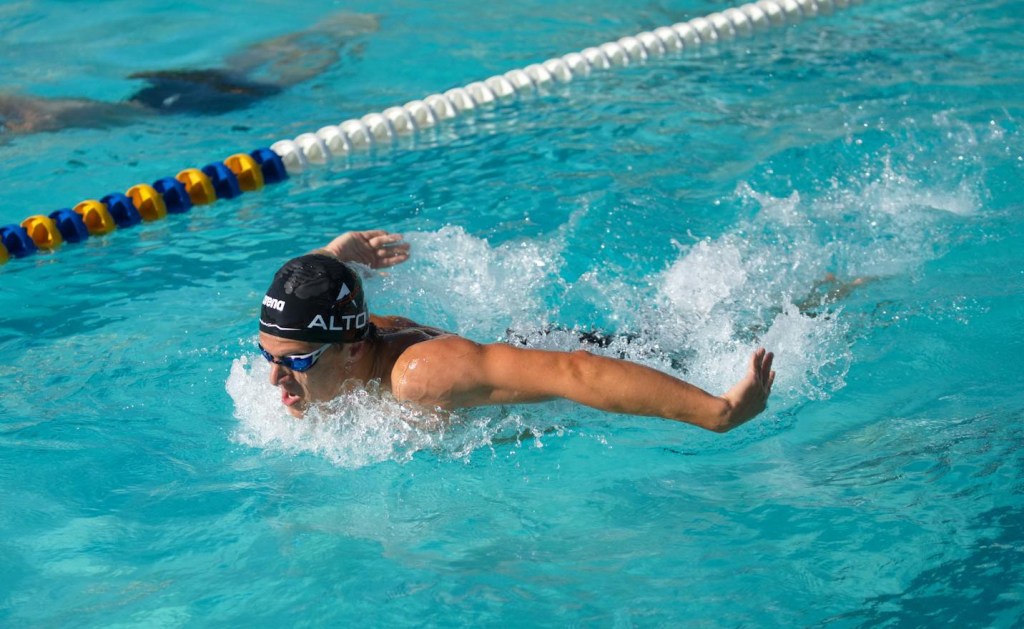
If the arms recovering above the surface are dragging on the water, a swimmer will stop. So, the natural solution is to lift up higher. Lifting your shoulders up high, arms up high and head up high creates a position of extreme arch. In this position a very difficult situation occurs; extra resistance and incorrect timing.
With the head up very high, the shoulders can get over the water. But the reason the head needs to lift high is the thumbs are pointing directly forwards. Except for hyper mobile people, shoulders don’t bend backwards with thumbs up. If you put your arms out to the side, with thumbs up, see how far they can go back. Not far.
In the above photo of a fly swimmer, you can see the fingers and thumb are relaxed and pointed backwards. That allows the head to stay low and the natural wave to continue without a hitch. Then as the arms begin to arch down, the head also goes down, making a nice smooth stroke.


 swimcoachingblog