
Too many times I’ve seen a swimming Coach standing at the side of the pool, looking over a pool full of swimmers, doing nothing and talking to no one. Or staring at their phone. Or sitting drinking a coffee chatting with another coach or a parent. Or even reading the paper. This is the conundrum of coaching: coaches don’t coach.
The noun ‘coach’ is a person but the verb ‘to coach’ means to be ‘teaching’. If ‘to coach’ is ‘to teach’, then it should follow that to be a coach should mean to be a teacher. Doing nothing however will reap no education and repetitively doing the same thing, according to Einstein, will reap you the same thing, even if you are expecting something new.
I propose that coaches no longer coach at all. They should teach. Somewhere along the way, a group of coaches must have decided that teaching is hard work so they would just write-up a workout and shout motivational lurid tidbits at the entire squad. True coaching is engaging and active, it is not in-action.
Bill Sweetenham, the National Performance Director of British Swimming, when I was part of his coaching staff at the preparation camp prior to Athens in 2004, made a series of rules for the coaches. His Moses-like statutes were:
- You could not turn your back to the pool.
- You could not use your phone or a laptop while on poolside.
- Any conversations you had must be brief and concise and if the conversation was important then it should be conducted before or after the pool session.
- You could not drink coffee while on poolside.
I thought he was crazy. And if you knew Bill you would know he was a bit crazy, however there was logic to his madness; he wanted the coaches to teach.
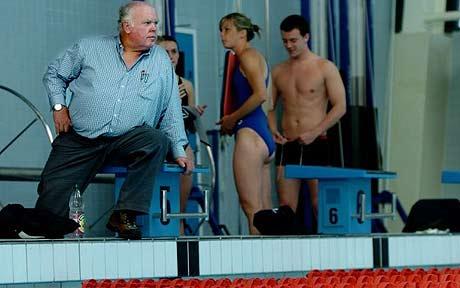
With Bill at the helm, if you were not engaged in your pool session and you simply wrote your training session on a white board and then stared blankly at endless repetitions, you were going to be found out. After the swim sessions all the coaches got together in a small room, normally very hot, and Bill, with a devious look that can only be perfected by growing up in rural Australia, would pick out one of the coaches and ask them to tell the group about their session.

Bill chats with Dave Calleja and Sean Kelly. Great British coaches.
Every aspect was picked apart, every interval queried and you were ‘on show’. The green coaches faltered under the spotlight but it became obvious to me that this was a tremendous learning tool for everyone. Even by faltering, the coaches learned. Painful to watch sometimes, as he picked apart a training session that was obviously designed either by someone else or slapped together without any basis, (or even worse; copied out of a Sweetenham book) but through this process everyone learned. So the crazy guy was a genius. (Except about the coffee).
The late great swim coach Dr James E Councilman wrote in his book: Competitive Manual for Coaches and Swimmers, 1977, p259:
Some head coaches like to take care of the details and leave the actual coaching of the swimmers to their assistant, while others just put up the workout and let the swimmers do it ‘on their own’. This type of coach has certainly misplaced his emphasis, for few of his swimmers’ needs can be fulfilled unless the coach is on the deck. There may be a few exceptions, but I have found that if you show me an office coach, I’ll show you a loser.
For a long time the teachings of ‘Doc’ have been available to the swimming world. They are still relevant today.
Teaching is an action, it is not standing still. A coach must challenge their swimmers and must be intimately aware of the experience that the swimmer is having so that they can react to the situation and adapt the training plan if necessary. For example; if a swimmer was starting to falter on a training set that required target times, like a race pace set, and nothing was done about it, then the swimmer would begin to adapt to the wrong pace and begin to undo the work done prior to that point. Or if a swimmer began to alter the way they powered their way through the water, because they were beginning to get overly fatigued, then the coach must intervene to either change back to the good form, or have them stop, or even have them do something else. Without an awareness of these things happening a coach would not be coaching, they would be standing on the side being as useful as a sleeping lifeguard, letting mal-adaptations take place.
 Coaches must understand that they are the leaders, so they must lead by example.
So if you are going to call yourself a coach, you should not coach; but teach. Then you would truly be a coach.
Do you want to join in the discussion with Gary? Join in his Skool and get started: https://www.skool.com/performance-swim-strokes-6754/about


 swimcoachingblog