In the early days of the Olympics the events in the pool were unusual and designed for entertainment. Here are some of the unusual events that you might not have known about.
In 1896 there was a swimming race that was approximately 100m but to participate you had to be Greek and you had to be in the Greek navy. This unique swim race must have helped the medal count for the Greek team! The winning time was over a minute slower than the race for all nations which was a separate event. The very rough seas on the day discouraged participation, eleven sailors had signed up but only three took part.

An Underwater swimming race was held in the Paris games in 1900. Races at these games were done in the Seine river. The winner was decided by the score given by adding one point for each second underwater and two points for each metre swum underwater. The distance was measured in a straight line from the starting point so the Danish swimmer who swam much further and was underwater longer did not win because he did not swim straight but rather did a semi circle. The river was very silty and muddy plus a current pushed everyone around.
Again in Paris in 1900, in addition to the 200m swimming event, there was also a 200m obstacle race. There were three obstacles. The competitors first had to climb over a pole, then climb over a row of boats, and then swim under another row of boats in the River Seine. The 200m winner also won the 200m Obstacle Event.
A race was held in St Louis in 1904 called Plunge For Distance. This ‘race’ was a completely static event where competitors dove into the exhibition lake and glided without any propulsion from arms or legs. The winner was Bill Dickey and he went 19.0m (62feet). There were eleven participants who were all from America. Competitors in the plunge for distance event began with a standing dive, then had to remain motionless underwater for one minute or until their heads broke the surface of the water, whichever came first.
Swimmers in 1904, 1912 and 1920 Olympics prepared for the 400m breaststroke. The long distance events were swum with Breaststroke but now a new Trudgen stroke or a side stroke was beginning to become popular as it was faster. So to keep the stroke of Breaststroke alive, they held a race of the 400m breaststroke. Later the 400 distance was shortened to 200m.
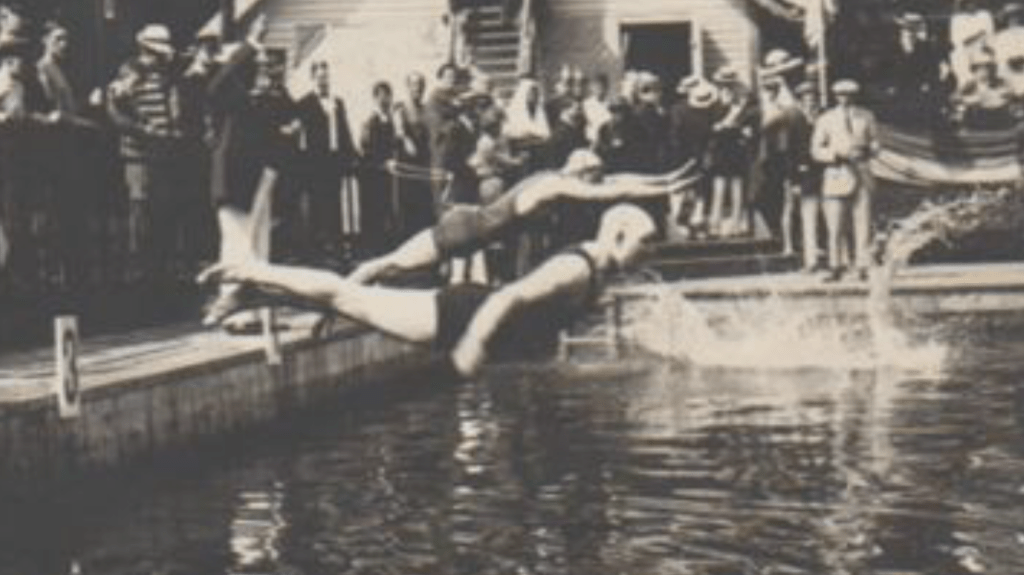
Swimmers in the 1948 Olympics swam different strokes in the same event. The 200m breaststroke was swum with a variety of arm styles, eventually leading to different events. Following the cancellation of 1940 and 1944, in the 200m breaststroke, most swimmers did Butterfly arms with breast kick. Seven swimmers all swam with an over-arm butterfly style with a breaststroke kick but only Bob Bonte of Holland used traditional breaststroke, coming eighth. The superiority of the butterfly technique in this event was evident, so finally in 1956 there were races for butterfly separately which once again rescued breaststroke from obscurity. 1956 was the first Olympics to have butterfly events; 100m for women and 200m for men and separate events for breaststroke not allowing over-arm strokes.

Do you want to join in the discussion with Gary? Join in his Skool and get started: https://www.skool.com/performance-swim-strokes-6754/about


 swimcoachingblog