To try to write an all encompassing blog about coaching all swimmers with a disability would be like trying to categorise all books into a library with only one heading. However the philosophy of coaching does not change: problem solving.
Coaching swimmers with disabilities is not different to any other coaching. Each swimmer has strengths and weaknesses. A coach will be aware of these things over time.
The strengths that a swimmer has, needs to be tested and trained. This is the normal aspect of coaching; energy systems and technical skills.
The weaknesses a swimmer has; poor flexibility, poor nutrition, lack of strength, poor technique and many other aspects must be addressed. Sometimes a swimmer lives a long way from the pool, sometimes a swimmer doesn’t have the finances to support their swimming. Swimmers with a disability also have challenges. Their unique situation must be treated factually. Sometimes it is the fact that a swimmer can’t do something because it is not there. So it becomes a fact and then true coaching happens; problem solving.
For example if a swimmer has dwarfism. They have small arms and legs. How to swim with that scenario? Also a swimmer with dwarfism has a proportionally extra large head. This means balance is dramatically affected.
You can not change these things, so you must think of ways to swim faster differently. How to solve these issues, or more accurately, these facts, so that the swimmer gets faster. This is the coach’s challenge; how to overcome.
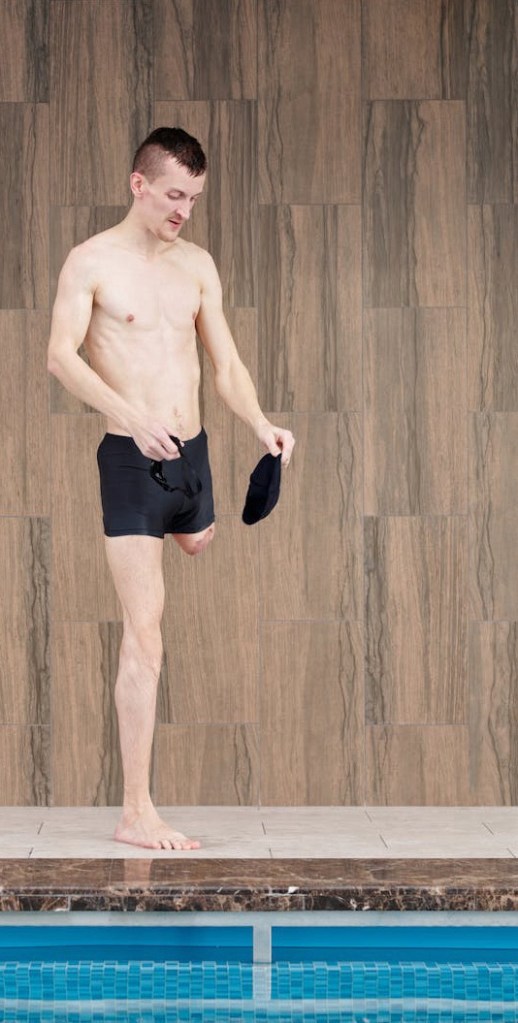
Some coaches worry about how to address the facts. A person with an unusual or atypical body is not ignorant of their body. It is not a secret. So talking about a stump, weak eyesight, palsy, or a myriad of things that happen at birth, or through life, is simply fact. Addressing them should be honest so that the process of problem solving can take place. What a swimmer can do and what they can not is important. Within those parameters lies true coaching.
For example I coached a swimmer with dwarfism. At first I could not sort out why it was so hard for her to swim. I could see she had small arms and legs but she stopped every 5 meters. After some thought and closer attention to her I realised her head was getting in the way of her balance. We talked about this fact and we came up with the solution. I started to have her use a centre mounted snorkel. Her swimming excelled. She no longer had to stop in the water and tread water to breathe. Her strength improved, her speed improved and so from there we sorted out the breathing problems.
The synopsise of coaching swimmers with disabilities is to approach swimming as a problem solving process. The problem is not the person but the process. It has to be more creative. That process is not actually very different to any other coaching; sorting strengths and weaknesses.
If a weakness is an aspect that does not exist, then it is not a weakness; it isn’t anything. If it can’t be changed it is what it is. It’s just a fact that some solution options you may have used in the past are not available. Like a chess game against an opponent you’ve never encountered. Your normal strategy won’t work.

I don’t like the term ‘thinking outside the box’. I don’t believe there is a box but some people put a box around their intellect. Like saying I can’t speak French. You’ve just not tried. But you could if you wanted to.
Observation of what can be done and what can’t be done needs to be a starting point. From there you must creatively find a solution based on the cold hard facts. This will make you a better coach by forcing you to find a solution to a problem you have never encountered before. Like how to dive from blocks without use of legs, or how to turn if eyesight is weak, or how to turn without arm function. The list is endless.
Any coach who shys away from this challenge is not a true professional and is not very creative. By putting yourself in a position of coaching swimmers with disabilities you are challenging your coaching skills. It challenges your ability to provide new solutions. It makes you a better coach.
Coaching swimmers with disabilities should be a module in coach qualifications. It is a CPD module that will not give you a certificate, but will give you a very big hug. I hope you pick up this challenge in your future if the opportunity arises.
If a you want a FREE game to laminate and use as a warm up. CLICK HERE.
Do you want to join in the discussion with Gary? Join in his Skool and get started: https://www.skool.com/performance-swim-strokes-6754/about


 swimcoachingblog