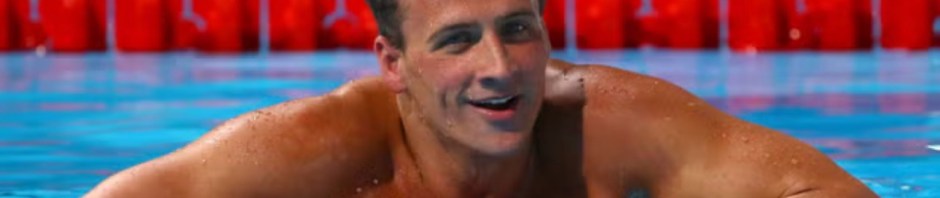
Recently, the press reported that Olympic gold medallist Ryan Lochte sold several of his gold medals—earned in the 800m relay at the 2016, 2020, and a third Olympic Games—for approximately $320,000.
Earning a living from swimming has always been a contentious issue. So the question arises: would you sell your medal if you had one? Or twelve?
Prior to 1992, any swimmer wishing to compete at the Olympic Games was required to be an amateur. This meant athletes were not permitted to earn income from their sport. In practice, however, no swimmer was ever disqualified for breaking the amateur rules.
I recall that some years ago Janet Evans earned endorsements and was allowed to compete at the Olympic Games, yet she was deemed ineligible to compete in NCAA events due to those endorsements. The rules of the NCAA followed closely the rules of the IOC. However she was a respected personality so she could endorse products.
Lochte has accumulated an Olympic medal count of six gold, three silver, and three bronze medals—a total of twelve. With endorsements likely having dried up due to the negative publicity surrounding him, what other financial options remain? Having sold three of his gold medals, his remaining tally now stands at three gold, three silver, and three bronze. A nice trio of medals… he had spares.
Amateurism was an offshoot of Olympism and rooted in class distinction. To spend time training for sport required leisure, and leisure was a luxury reserved for the wealthy. A “gentleman” was defined as someone who did not work for a living; those who did were viewed as inferior and beneath the genteel class. Amateur rules were designed to ensure that competitors came only from this privileged background.
One of the greatest swimmers of all time, Duke Kahanamoku, came from a poor Native Hawaiian family. Throughout his life, he promoted Hawaiian culture worldwide and deliberately avoided earning any income connected to his swimming so that he could remain eligible for Olympic competition. One of his famous contemporaries was Jim Thorpe, a Native American of the Sac and Fox Nation. Thorpe won both the decathlon and pentathlon at the 1912 Olympic Games in an extraordinary display of athletic ability. However, in 1913, his medals were stripped after it was revealed he had played semi-professional baseball. So Duke was well aware that remaining strictly amateur was essential to his ability to compete at an Olympics.
In 1992, everything changed. The introduction of the U.S. basketball “Dream Team” marked a decisive shift away from amateurism. These athletes were earning between $2 million and $7 million per year in the NBA, signalling the end of the Olympic ideal that athletes must compete solely for the love of sport.
Yet swimmers never benefited from this change in the same way. They do not make millions. The average swimmer earns between $10,000 and $30,000 per year, with only a handful at the very top earning substantially more. Perhaps Lochte felt he had been denied the financial rewards typically afforded to elite athletes in other sports, despite being one of the most decorated swimmers of his generation. That left him with one practical option: sell some of his medals.
Lochte could have followed the path of Duke Kahanamoku—living a modest life, supported by goodwill, with a simple job near the beach and no financial return on his athletic success. In a constant battle to pay bills. But Lochte lived in a different era, one that allows athletes in most sports to capitalise on their achievements. He chose to convert part of his legacy into financial security. With nine Olympic medals still to his name, he did not erase his achievements; he simply monetised a portion of them. And unlike Kahanamoku, Lochte could not rely on public goodwill to sustain him. In that context, selling his medals was not a betrayal of Olympic ideals, but a rational decision in a system that has long undervalued swimmers.

If you would like more mentoring with Gary Vandermeulen please sign up to Skool at


 swimcoachingblog
This also explains why the relatively large sums of money involved in the Enhanced Games must be so tempting to elite level swimmers reaching the end of their competitive careers.
LikeLike
I think it might entice swimmers who are willing to try anything to swim fast and not just be trying to earn a wind-fall
LikeLike