The words we use are important. They carry a lot of baggage though. Your awareness of your words must be thorough because some words mean a different thing than what you think they do.
Try the word ‘kick’. If I told a toddler to kick a pillow, I imagine every one would wind up and kick the pillow just like they would kick a ball. So if you tell any age of person, to kick, they would wind up and boot it. Many new swimmers struggle to use their legs correctly.
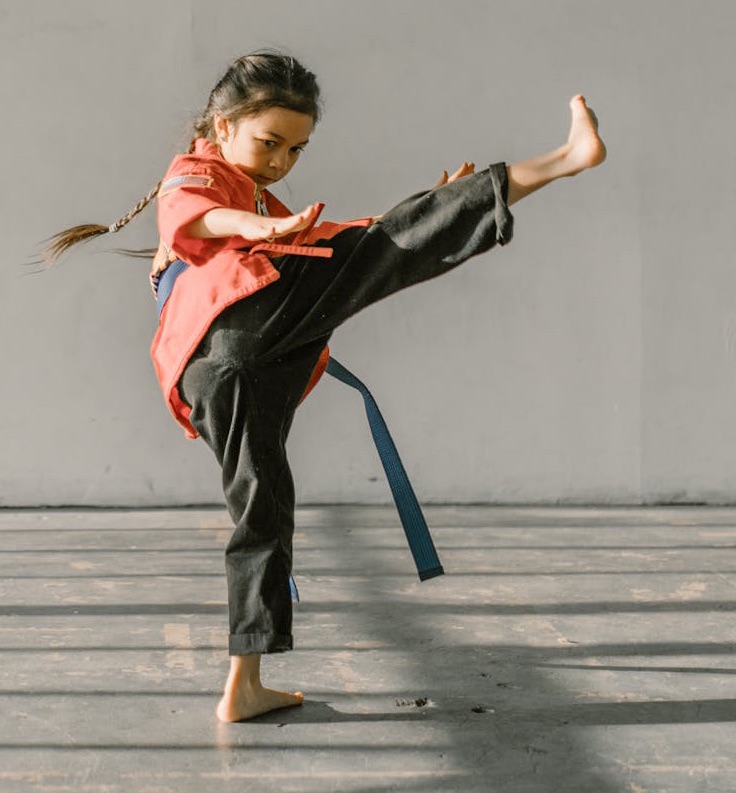
In swimming we call the leg movement of frontcrawl a kick. This is wrong. We don’t kick, what we do is very different to kicking.
If you’ve been in a hot country and used a fan to swish air at yourself to cool down you’ll know that it can only be done one way to get the swish. The fan can’t be pushed towards you like a fork and can’t be pushed through the air all at once. What you do is fan in a curved sweep.

Fanning is a slightly odd thing to describe but not hard to do by watching…and then trying. Using a fan is easily learnt. Once you feel the air swishing against your skin you know how to do it.
In swimming what you do with your legs is swish the water away from you to push you in the opposite direction. You fan your legs. you don’t kick them. You swish the water just like you swish a fan. With that as an image teaching the leg movement becomes much quicker to learn.
Your arm action is referred to as a pull. If you have a tug-of-war with someone using a rope; then you are pulling. With your hands gripping the rope, you pull back leading with your elbows.

If you pulled in the water you would go no where. To correctly use your arms you need to use your hands and forearms as a paddle and press the water. After you reach the half point under your shoulders you then push. Pulling is not the same as pressing and pushing.
If you are a person introducing something new, be aware of using words that can have other interpretations. A kick is not what you want in water and a pull isn’t either. Oddly that is the words that are commonly used because we are predominantly land-based.
If you want a FREE game to laminate and use as a warm up. CLICK HERE
Do you want to join in the discussion with Gary? Join in his Skool and get started: https://www.skool.com/performance-swim-strokes-6754/about


 swimcoachingblog
Pingback: Mimicry Learning | swimcoachingblog
I agree with your thoughts on the words ‘kick’ and ‘pull’. I had a similar conversation with Jonty Skinner a while back. He doesn’t like the term pull, either. I told him that although the majority of the arm’s propulsion comes from the hand, which is being used like a paddle to generate the force, the term pull is tricky. When the hand is in front of the shoulder, the muscles are essentially ‘pulling’ the paddle backward, yet when the hand passes the shoulder, the muscles are essentially ‘pressing’ the paddle backward. So both terms can be used.
As for the kick, the motion of the legs and feet are unlike any other that I am aware of in sport. Again, most of the propulsion is coming from the feet which move downward, forward and upward…but not backward. Perhaps my old coach, Doc Counsilman, had it right. He never called the motion dolphin kick. He referred to as ‘fishtail’ which is exactly what we are trying to replicate.
The challenge here is that when something is called by the wrong name for so long, whether correct or not, it becomes synonymous with the act or thing. For the swimmer’s kick and pull, probably a little late to change it now.
Gary Hall Sr.
LikeLike
Gary Sr, thanks for your comments. Our paths have occasionally crossed. Back in your Phoenix days. I always catch myself saying kick and more recently thought of the idea of fanning. Fishtail is obviously exactly right. I like to stay in touch with my coaching skills by also teaching the preschoolers. On one demonstration I did in the water, one child said ‘it looks like you don’t have any bones in your feet!’. That I use now too.
I like press/push but the only thing missing then is ‘the catch’ which has to be done correctly or the rest is a bit of a mess. When I was young, I remember a club of well tanned teen boys from Santa Clara at the Keyano International who all seemed to have abnormally large triceps…which really lit a lightbulb for me to the importance of the finish (push for me, press for you).
LikeLike
Gary Sr, did you read the PhD doc on race pace? I found it very interesting. I thought the very short rest sets were more specific and with only very short rest.
LikeLike
It was published and shown at the recent US coaching conference, which I didn’t go to, but the doc was linked in the same forum in FB that you linked to me on. If you haven’t read it I can find the link.
LikeLike