
When I grew up I couldn’t wait until the ‘SWIM’magazine came in the post. There was always interesting articles to read about swimming, but as a nine-year-old I wasn’t too bothered about that content; I went straight to the swim rankings (called TAG rankings for Top Age Group rankings).
It’s important to imagine what information was instantly available in 1975. In 1975 there was nothing. No online results, no TV programmes that showed swimming (except the Olympics every 4 years) and no way to know what other swimmers in the world were doing…except via the SWIM magazine. Certainly it was not possible to know what other swimmers your age were doing in Fredericton or Saskatoon.
The magazine was the only link to the outside world. Today we already take for granted that if someone asks you a question you don’t know, you would automatically whip out your mobile phone and within seconds have the answer. Not so in 1975.
The Publisher and Editor of the SWIM Canada magazine was Nick J. Thierry. A prominent swimming coach in eastern Canada. He was a bit of a statistics nerd. In fact he was a big stats nerd. If you had the pleasure of every meeting him you would know he was kind, knowledgable and unflappable, but unquestionably a swimming geek, happiest compiling swimming times.
Nick was solid as the Canadian shield and so were his statistics. I can’t say that about todays online stats. Nick would roll over in his grave if he saw how inaccurate the rankings pre-2000 are, all that work gone to waste. I digress, my point is that the SWIM magazine was everyone’s only link to the outside world of swimming in Canada.
 Future CBC colour commentator Byron MacDonald looking very confident and very ‘seventies’ in the August 1975 issue #18.
Swim rankings were compiled for all races done in Canada and each race was ranked fastest to slowest, stopping at top 25. The rankings divided swimmers by gender and age. I was in the 10 & under category in 1975. Each month (except September) a copy would come in the mail. It was the masterpiece of Thierry. The huge geographical distance shrunk into 25 places.
I knew I had to get my name in this magazine after the first one miraculously appeared in the mail. My swim fees included a subscription to the SWIM Canada magazine via a fee to the national governing body CASA (Canadian Amateur Swimming Association).
Each month the magazine arrived but sadly I didn’t see my name. The solution was straight forwards, I had to be faster.
I absorbed the rankings, worried over them, studied them and was haunted by them. I looked at how old the swimmers were, where they came from and what other events they made the rankings in. I probably knew more about Alex Baumann statistically than anyone except Dr Jeno Tihanyi. I knew his times in his distance events showed he even split all of his events by doubling up his shorter distance times. I knew he was swimming faster than swimmers a year older than him. I knew that he was ranked in all strokes and that he was very highly ranked in all the distance events, in every stroke. Later in my life, in 1984, I watched the culmination of those statistics, a lifetime’s swimming when Alex Baumann won the 200im and 400im at the 1984 LA Olympics. I wasn’t surprised, statistically he was the best swimmer in the world. Didn’t everyone know that??
How did Thierry manage to compile all the times of all the races in Canada into one magazine. The task was massive and the solution genius.
If you raced in Canada in the 1970’s, or later, you held a time card in your hand before every race. It became ubiquitous in the swimming world, the creation of swim coach and statistician; Thierry. I didn’t know it when I was young but the time card was the link to the swim magazine rankings. Every card, of every competition, went to Theirry and he compiled the rankings. By hand and typewriter.
The hobby of a swim coach became a full time job later in his life and helped to form many young swimmers’ motivation in their life: getting their name in the Swim magazine.
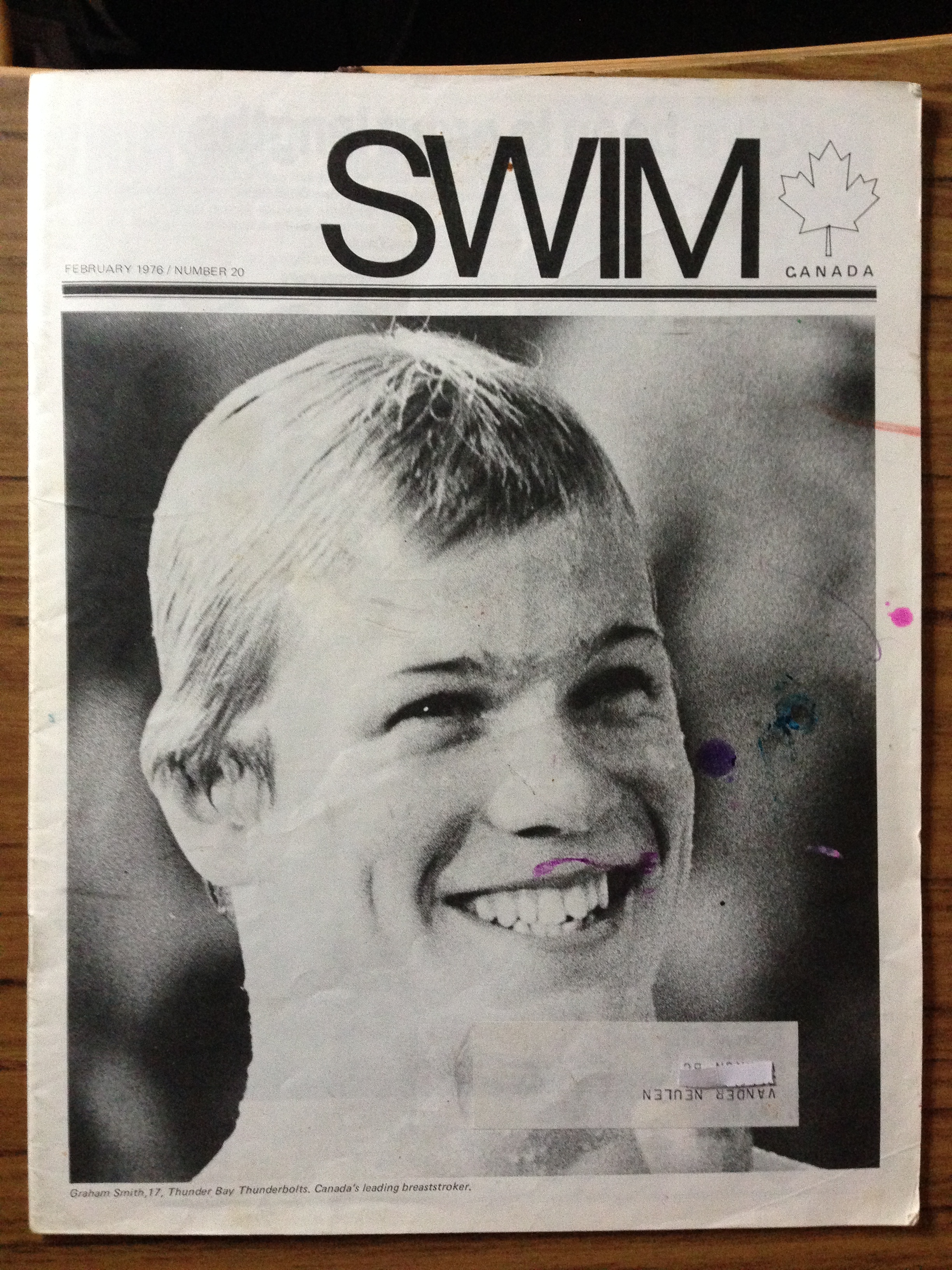 (A young 17yr old Graham Smith just months prior to an outstanding three finalist places and a Silver medal on the medley relay at the Montreal Olympics)
At the end of the swimming season a longer ranking would be published. This was the top fifty swimmers. So if you didn’t get into the monthly editions, the top 25, but you were close, like I was, then maybe (“just maybe! hopefully, desperately”) in the summer edition you’d get to see your name in the national magazine. Sure enough, although the August 1975 ‘Byron MacDonald’ edition didn’t have my name, nor the February 1976 ‘Graham Smith’ edition, maybe in the June 1976 edition. On the cover was Deryk Snelling my future coach:
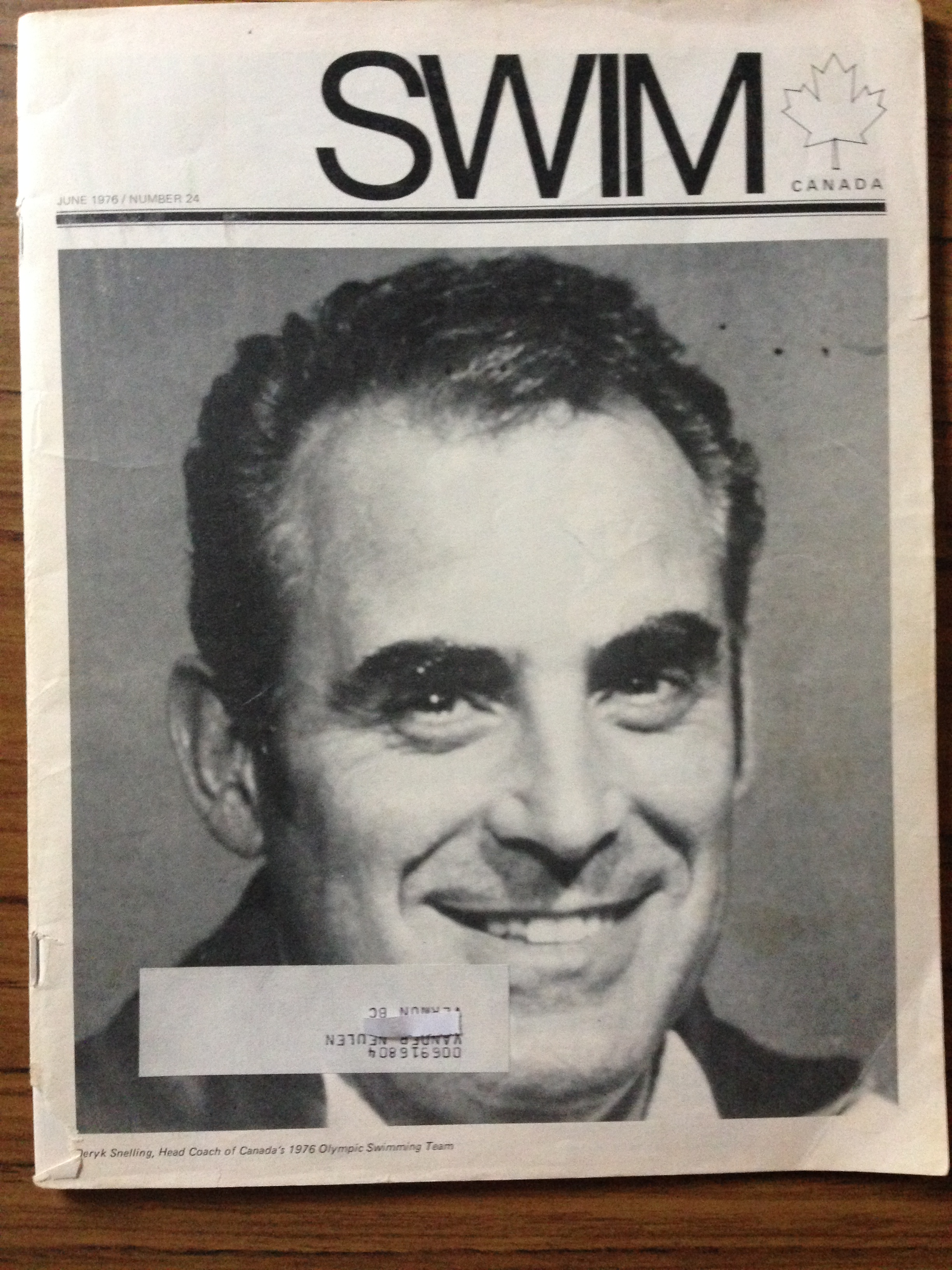 The June 1976 edition had a photo of the Head Coach of the Montreal Olympic team; Deryk Snelling (my future coach)
The top 50 rankings would be in this magazine. I raced to see if I finally made it. I hunted for the 10 & Under Boys rankings, then scoured each event. And then, there I was, in the SWIM magazine, ranked in the 100m Butterfly! I was one of the best, one of the top in the country. For a ten year old, it was magical and so satisfying to see my name in print. (Obviously necessary to be underlined!) An amazingly powerful motivational tool.
 First rankings in the national magazine for me!
Rest in peace Nick. We all miss you.
Do you want to join in the discussion with Gary? Join in his Skool and get started: https://www.skool.com/performance-swim-strokes-6754/about


 swimcoachingblog