
I have recently had the opportunity to help improve the swimming skills of a young lady called Rosie with dwarfism. I have always been interested in teaching athletes with odd quirks of genetic fate. Maybe because I was also one of those individuals who was dealt a hand that gave me unique challenges too.
Adaptation will provide every swimmer with the keys to success. Determining what to adapt takes a partnership between a coach and swimmer. It may mean becoming more aerobically fit, more flexible, or in my life; finding a way to swim fast with only one pectoral muscle. For some people the adaptation might not be physical, it may mean overcoming financial constraints or simply getting to a pool which is far away. For many it is psychological.

Teaching a swimmer with dwarfism presents some interesting challenges that may not be immediately obvious. They are not simply small people but they have atypical body dimensions. Undoubtedly you have seen a person with this interesting fate on television so you will know that they are intellectually equal but have short limbs and a big head.
This creates an immediate balance problem but luckily not a communication problem. A large head makes balance exceptionally complicated because it is an issue I see regularly in most swimmers any ways, so this common problem is exacerbated with a person with dwarfism.
I watched Rosie swim in my training group once a week and tried very hard to help her. Her strokes seemed self taught and almost completely lacking in good forward propulsion. Her stroke was ‘survival’ from one breath to the next, with a hint of the stroke I had asked her to complete. If she swam more than 10m at a time before stopping to rest (or fix goggles, fix cap, poke pals, get out to go to toilet, take a drink from her water bottle, or anything to stop) it was unusual. Her stroke was as exhausting to watch as it was to swim. She constantly played with her lane pals when I was giving directions because there was no way she could do what was asked anyways, so directions were a moot point and so she kept interest by playing with her lane pals. She progressed… ‘zero’. I spoke to her father and asked if he might consider 1-2-1 tuition for her. Happily he agreed.
 With many swimmers head position is too high or too low. Our head is heavy and impacts a stroke a great deal.
What I did without any other swimmers to distract us was this: I watched her swim very closely. I know that every movement had a purpose. I asked myself, “Why did she do that”..”and that”…”and that”. Then it was obvious. She simply had a very big head and it created such an imbalance that it made her very close to vertical, especially when she took a breath. She struggled to get a breath because of her unbalanced position in the water but needed lots of breaths since she was working so hard. She almost always stopped every other breath to rest.
Sirandipitiously at the beginning of our very first 1-2-1 session; she had forgotten her goggles. As always, I had spares. She tried mine but said the straps were too tight, so she jokingly said ‘I got a big head’. We had a chuckle together because we both knew that was obvious and I knew from many other swimmers with genetic (or otherwise) idiosyncrasies, we can laugh about ourselves (it’s everyone else that’s uptight).
Once I had ‘clicked’ that her swimming style with high head position was the problem, that is trying to keep her mouth close to surface, I set out to help her with that common problem. To help resolve the body position problem I try to explain what I am doing so that the swimmer remembers, I said; ‘well Rosie, you said it already, you got a big head’. We laughed again at our private joke. So I explained why this would be a problem to overcome in swimming.
Breathing was the problem. Getting your mouth around to breathe was tricky for her. She had to twist around and try to get higher horizontally to breathe. Her swimming was already hard and simply stroking from breath to breath trying to adapt. She fought the water while struggling to get her mouth above surface which created a breaststroke style kick into all her kicks. She worked hard to get every breath. Then I knew the answer…
I eagerly hunted through her kit bag…there it was…never used, in perfect working order, a centre mounted snorkel (CMS)! Yes!
I showed her how to get it on. How to breathe comfortably and how sometimes water may get in the top if the top end submerged. Then we began with all the basics, which she struggled to complete because she’d never swum more that 10m without stopping. But Rosie was actually very good at kicking. I had just never seen her do it for more that two kicks in a row. She was excellent at using ‘floppy’ feet and as is the case with most people with dwarfism she was quite hyper-extended in her knees. Both conductive to an excellent kick. Kicking correctly and swimming towards consistency for 25m was now possible. We worked on going further and further without stopping using the CMS.
Once the kicks were stronger, we worked on arms & full stroke. Always with the CMS. Using a variety of drills I discovered the ones she could do and then moved on to full stroke.
Backstroke presented a difference problem.
 I make notebooks with my drawings on the front which I give to reward swimmers at camps or purchase if they like. Write it down! I always encourage swimmers to write notes.
On her back Rosie was basically underwater, again because she had a big head in relation to her body. So the breathing was again an issue. Everyone knows that water-up-the-nose is no fun. Solution? Nose clip. I dug through my coach bag and found a clip. It worked a charm. She could go further without stopping and gained fitness on the correct stroke.
Now we are progressing with her strokes and I hope to someday see her travelling the world with an international team.
I learned a lot working with Rosie and will continue to do so. You may be working with unique people too but the question you have to ask will be the same as you watch them swim: why do they swim the way they do?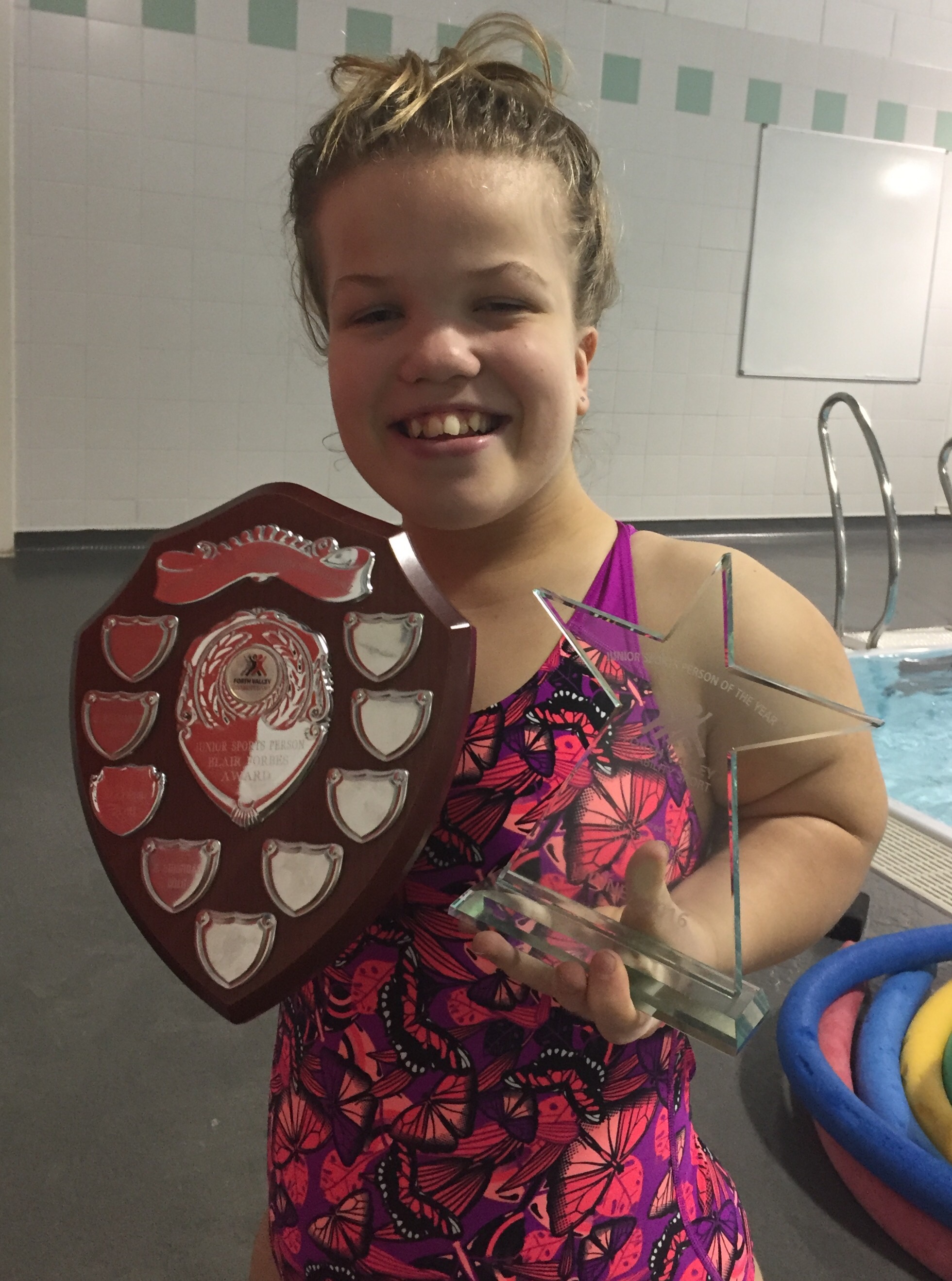
Rosie very recently won Clackmannan’s athlete of the year for her new Scottish records!
Do you want to join in the discussion with Gary? Join in his Skool and get started: https://www.skool.com/performance-swim-strokes-6754/about


 swimcoachingblog
Pingback: Coaching Disability Swimming | swimcoachingblog
I just want to thank you ! My daugther has hypochondroplasia, which is another form of short limb dwarfism. Instead of trying to help her overcome her challenges her swim coach would let her drink the swmming pool water with every stroke (she comes out of every session saying that her stomac hurt), and want to keep her in the “young kids” group next year while the rest of her group is going to the next level. It’s infuriating that they won’t ever consider thinking of an accommodation to help her learn !
LikeLike
Justine, thank you for messaging, you’ve made my day. If your daughter is old enough please have her read this. Maybe her coach might find it interesting since I found coaching this swimmer very challenging (in a good way) until I coached her 1-2-1. Good luck! Gary
LikeLike
Wow awesome.
LikeLike