
We’ve all looked at old freestyle swimming records and thought that they were slow. However if you knew that the old records were done with a breaststroke stroke, you might be less critical. Speedier times came with innovations that gradually changed into the freestyle of today.
Free (a common term today for freestyle) was surprisingly, firstly, breaststroke. In the early 1800’s Breaststroke was done without splashing by Gentlemen who prided themselves on their smoothness and non-splashiness, trying to emulate swanlike calmness and beauty. A gentleman did not ‘work’ by definition, so they were the only people who had leisure time to swim. A commoner worked from sunrise to sunset with no leisure time. Soon though, the middle class emerged and had leisure time. Then like everything men do; it became competitive. The shorter races created attempts at new quicker ways to move through the water but longer swims remained breaststroke.

The first change came when Breaststroke morphed into Sidestroke. Sidestroke is basically breaststroke on your side including arms staying under the surface. Most swimmers don’t naturally do breast kick correctly, with both feet turned outward, but instead naturally scissor kick. The scissor kick is also known as a screw kick and is very hard to change if done for any length of time.
Side-Stroke swimmers soon began to evolve their stroke and some swimmers began to lift one arm out of the water. It became known as a single-arm-over side-stroke.
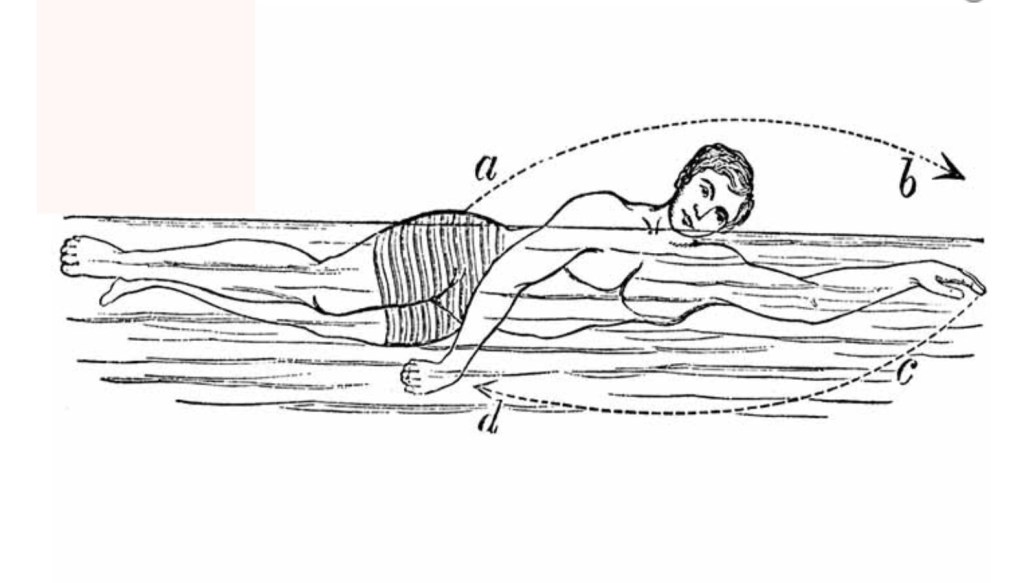
To win races against the single-arm-over side-strokers, John Trudgen, of Lambeth Baths in London, developed what became known as The Trudgen Stroke. He brought both arms over on the recovery while his kick was half breaststroke and half sidestroke kick. Swimmers began to emulate Trudgen which became the next dominant way of racing. However this stroke was not used in distances over 200m. This was written in the Sydney Referee on July 11, 1900:
“ Even the best swimmers of the trudgen rarely use it for a race of more than 100 yards. In fact, the only man who depends upon it for any distance race is Fred Lane. That it is harmful to have to use this method of progression is shown by the fact that he is frequently so exhausted that he has to be assisted out of the water, sometimes bleeding freely through the nostrils from the strain. He has also been known to be quite prostrate for hours after the race. Never use the trudgen stroke except for short distances!”

Freddie Lane was Olympic champion in Paris in 1900. Using the Trudgen stroke.
It has to be remembered that long distance swimming was seen as almost miraculous.

In Sydney, Australia, a family of indigenous South Pacific Islanders from Solomon Islands moved into the area of Lane Cove River. In typical fashion of South Pacific families, children spent hours in the water; surfing, boating, sailing, fishing, swimming, and playing in their aquatic playground.

If your back garden was like this, it’s likely could swim.
A coach of the time, George Farmer, likely of Trudgen-ilk, saw a brown-skinned pre-teen (Alick Wickham) skimming along quickly in the surf and invited him to join in the local Bronte Baths club races. In the short distance race, swimming faster than anyone he’d seen, he commented ‘he looks like he’s crawling’. He was only 1.5s off the world record and set the fastest time ever done in Australia in 100yds.

Swimmers from Australia began to use this two arm crawl stroke with various combinations of kicking. Fred Cavill, another famous champion Australian swimmer, swam against a woman in Samoa, she did virtually no kick and almost beat him. Cavill wrote home to his equally proficient brothers describing her unusual stroke. Cavill swam with a huge two-beat kick. His kick was described by Charlie Bell, in a letter to Forbes Carlile (an Australian swim coach researching the stroke), he recollected Cavill as two-beat during which he lifted his leg so high it smashed down and soaked spectators.
As swimmers like the Cavill brothers began to travel the world to race in special events, coaches and swimmers began to emulate the fastest styles.
In the 1921 ASA manual on Swimming and Swimming Strokes, of the variety of topics, three chapters are dedicated to these strokes;
The Trudgeon Crawl Stroke
The American Trudgeon-Crawl Stroke
The Crawl Stroke
The Trudgeon Crawl Stroke first developed with one scissor kick where one leg was bent up from the knee and vigorously thrashed downwards, known as The Trudgen. It was believed that this massive kick was the ultimate propulsion. An alternative came with a double Trudgen thrash. These two styles became known as ‘single’ Trudgeon-Crawl and ‘double’ Trudgeon-Crawl.
The American Trudgeon-Crawl Stroke seems to be the origin of the future freestyle, however with the head up. The kicking style was two beat (one kick per arm rotation), or a four beat style, which often was a kick style which was similar to the two beat kick except each leg kicked down twice ( for example right-right followed by left left), and the six beat kick. The head up style was emulated by Duke Kahanamoku and then Johnny Weissmuller.
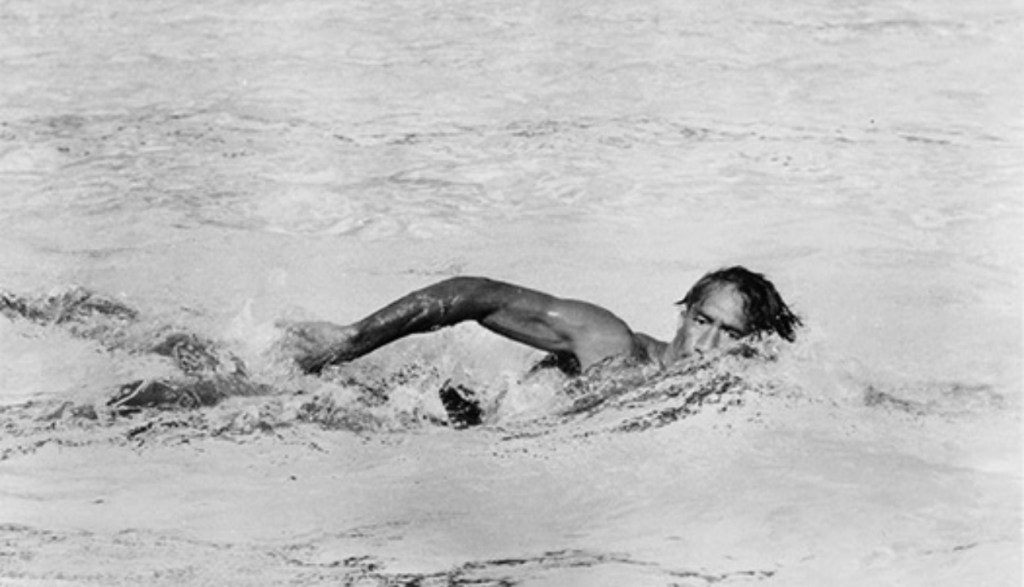
Most swimmers decided themselves the style they swam, so the six beat kick was rare. It was considered far too exhausting. The six beat kick was first made successful by young girls who were taught at a young age to do a fast kick by their coaches. Men who had found success with their own Trudgen style would not risk attempting a new style, the new innovations came from girls aged 9 to 13.
The Crawl stroke was described as having two styles: those who swim with breaths every stroke and those who breathe every four or five strokes. This breath holding stroke is described as exceptionally tiring, good for only 100m. The Crawl was used only in short distance swims and variations in kicking were called beats for the first time.
Considering it was ‘Tarzan’ who was the first to drop under one minute, (Johnny Weissmuller) in 1924, it would seem like only a super human with perfect physique could swim that fast! Once the head position became lower, the six-beat kick style dominated the sprint events.

I remember distinctly the swimmer Rowdy Gaines describing how he lifted his head on his breakout ‘to get on top of the water’ after winning the 100m free (ABC interview at LA Olympics in 1984). The lower head position that we see today is a new innovation popularised by Bill Boomer. His balance based style has brought freestyle (or ‘breaststroke’) to the standards of today.
With the innovative ways that swimmers and coaches improved swimming, like the unique one-beat-kick of Katie Ledecky or the fly-kick-free of Michael Klim, it continues to be fascinating to me and I wonder in what direction ‘breaststroke’ go from here?
Do you want to join in the discussion with Gary? Join in his Skool and get started: https://www.skool.com/performance-swim-strokes-6754/about


 swimcoachingblog
Pingback: How Breaststroke Was Saved…Twice | swimcoachingblog
Pingback: A Giant Killer | swimcoachingblog
Pingback: Olympic Swimming Events You’ve Never Heard Of | swimcoachingblog
Wasn’t the Australian crawl a skill stroke with stroke rules, the arms and legs must coordinate? American cheated with 4 or 6 beat kicks an beat Americans. To solve the argument it became freestyle, no stroke rules
LikeLike
Not that I know of but it could have been later on. Not in 1921 but I wasn’t reading the rule book just informational text from the time
LikeLike
What? Nothing about Doc Counsilman and the importance of an Early Vertical Forearm (EVF).
LikeLike
Doc Councilman might have done that. I’ll have a look in his textbooks
LikeLike
Wow! Thanks
LikeLike